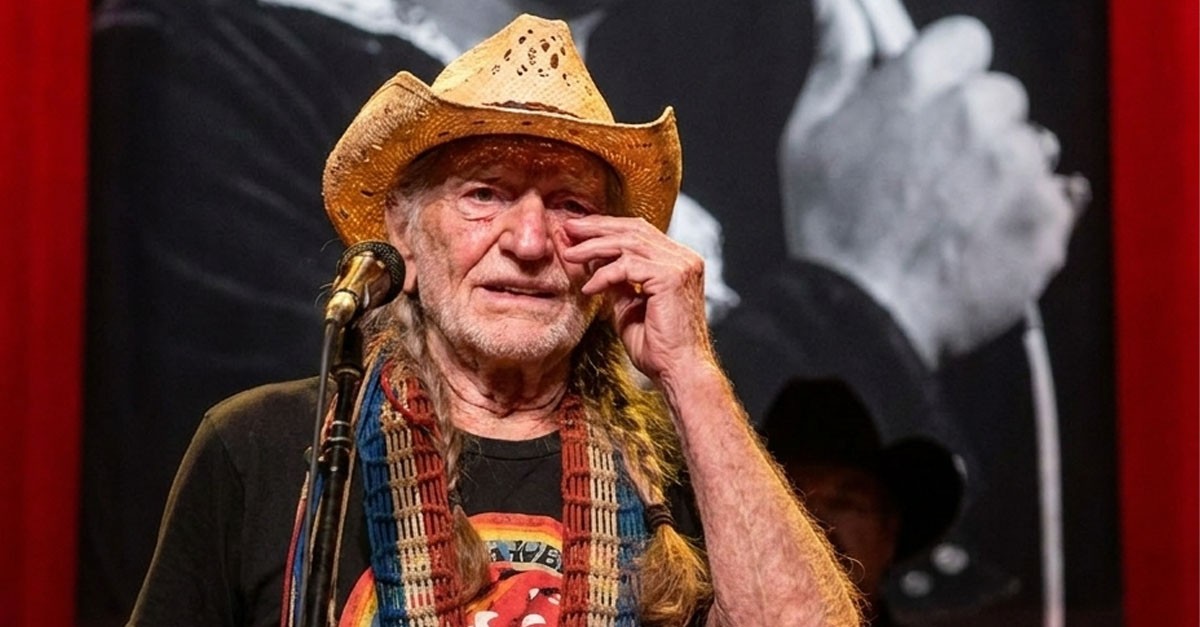
So when Willie Nelson reached out and placed his hand on Alan’s shoulder, the gesture carried a meaning far greater than words.
It was not pity. It was recognition.
The imagined silence of that moment says everything. No band. No applause. No spectacle. Just two country music giants standing together beneath a single spotlight. Willie’s quiet words “You carried it well, son. That’s all a man can do” would resonate because they speak to something universal: every life contains burdens, and dignity is not measured by how long we remain untouched by hardship. It is measured by how faithfully we carry what we have been given.
Alan Jackson’s hands, resting on his guitar, represent a lifetime of work. Those hands wrote and played songs that became part of the emotional vocabulary of country music. They gave voice to people who felt overlooked, heartbroken, hopeful, or grateful. To see those same hands now resting more carefully on the instrument is undeniably painful but it is also a reminder of what they have accomplished.
And Willie’s role in the moment matters just as much. He does not attempt to rescue Alan, speak over him, or turn the scene into a performance of his own. He simply stays. He offers support without taking away Alan’s dignity. Then, when he says, “One more,” he is not demanding that Alan prove anything. He is inviting him to share one more truth with the people who have loved him.
That distinction is important.
Some may argue that scenes like this are too sentimental, too carefully crafted to provoke tears. They may say that audiences should remember artists for their greatest performances rather than focus on illness, age, or physical limitations. There is truth in the concern: legendary musicians deserve to be seen as complete human beings, not reduced to their struggles.
But honoring vulnerability does not erase achievement. It deepens our understanding of it.
A wheelchair does not cancel Alan Jackson’s legacy. A trembling voice does not erase the songs. Age does not disqualify an artist from being celebrated. In fact, moments of limitation can reveal the courage behind a lifetime of creation. The goal should not be to pretend that hardship is absent. It should be to recognize that meaning can remain—even when strength changes.
When Willie joins Alan after those first quiet lines, he does not take over. He supports him. That may be the most powerful image of all. True friendship is not always about fixing what hurts. Sometimes it is about standing close enough that the other person does not have to carry it alone.
The audience’s response matters, too. They do not erupt in the usual way. They stand, remove their hats, and allow their emotion to speak. Their silence and tears become an act of gratitude—not only for the performance, but for the years of music that made the moment possible.
And when Alan says, “Y’all take care of the music,” the message reaches beyond the stage.
Taking care of the music means preserving the stories, values, and honesty that country music at its best has always carried. It means listening to older artists instead of treating them as relics. It means supporting musicians through illness and changing circumstances. It means remembering that behind every beloved song is a human being who has endured, sacrificed, and continued to give.
Whether this moment is remembered as a real event, a symbolic scene, or a reflection of what fans wish they could witness, its emotional truth remains powerful: artists do not stop mattering when they can no longer perform exactly as they once did.
Alan Jackson’s legacy is not contained in his mobility, his volume, or his ability to command a stage. It lives in the songs. It lives in the memories of listeners. It lives in the people who found comfort, courage, and companionship in his music.
And Willie’s hand on his shoulder reminds us that no one should have to face the final chapters alone.
So let us do what Alan asked. Take care of the music. Play the songs. Share the stories. Support the artists who gave us their best years. Show up not only for the triumphant performances, but also for the quiet, difficult moments when a person needs respect more than applause.
Honor Alan Jackson not with pity, but with gratitude. And honor every aging artist by proving that their worth was never dependent on standing alone beneath the spotlight.